Preamble
We, the founding members of the Rashtra Shaktibadi Party, resolve to build a disciplined, transparent, and democratically governed political organisation dedicated to administrative reform, youth empowerment, and inclusive socio-economic progress for the people of India.
This Constitution is adopted as the supreme governing document of the Party. It binds every member, office-bearer, and unit of the Party, and no rule, circular, or directive issued by any Party body shall stand in conflict with it. This Constitution operates as an internal governance document and does not, by itself, confer statutory recognition; such recognition is separately sought from the Election Commission of India under the Election Symbols (Reservation and Allotment) Order and the Representation of the People Act, 1951.
Name, Symbol, Colours & Headquarters
Article 1 — Name
The Party shall be called the Rashtra Shaktibadi Party, abbreviated as RSP.
Article 2 — Symbol & Colours
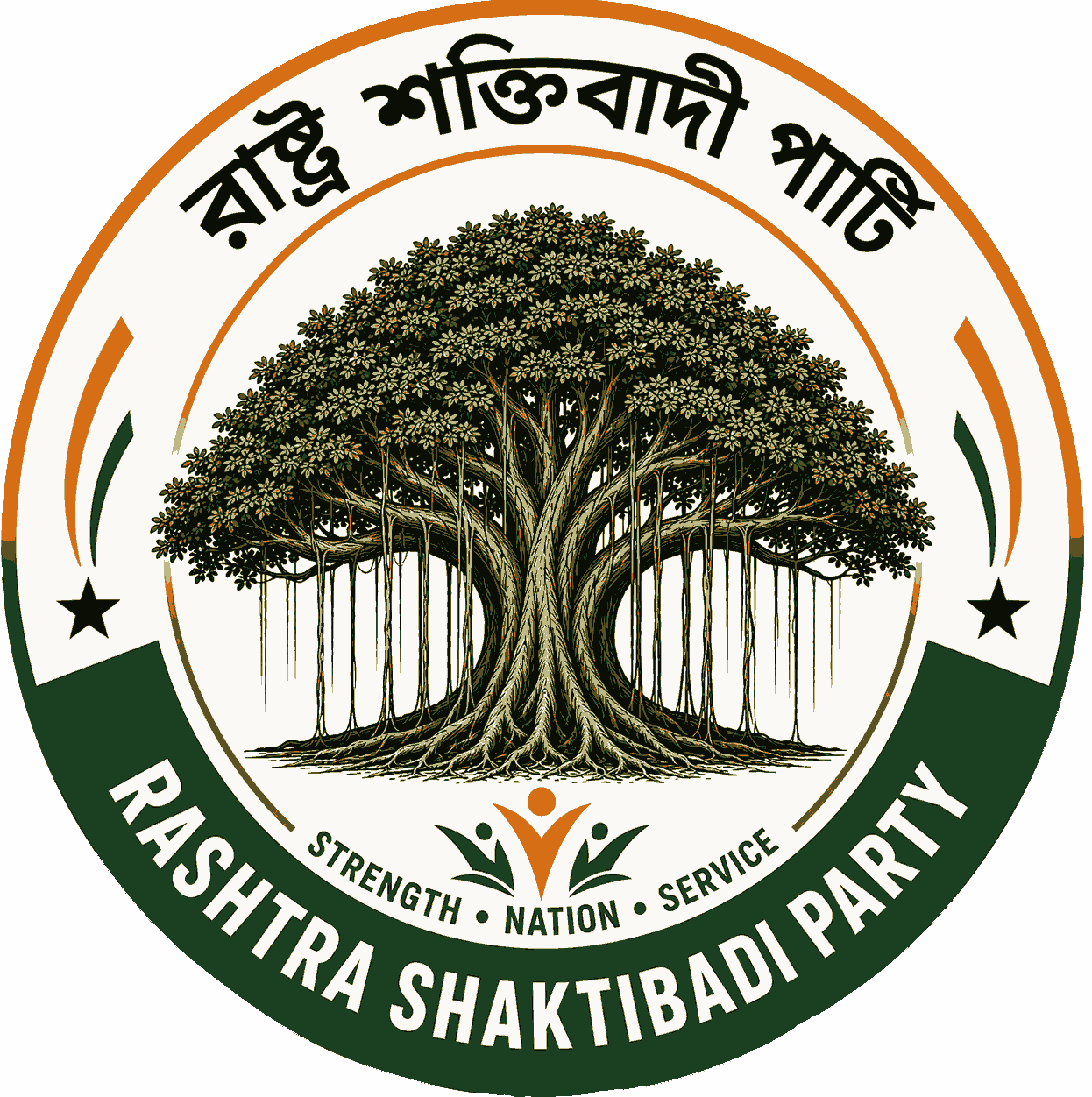
The Party's official emblem is the Banyan Tree, enclosed within a tricolour ring bearing the Party's name and the motto "Strength · Nation · Service." The banyan's wide, aerial-rooted canopy represents every class and section of the population, spreading out from a common trunk and capable of sheltering the whole nation under one unified structure — while its hanging roots symbolise the Party's grassroots connection to the people at every level of society. The Party's official colours are saffron-orange, white, and green, drawn from the national tricolour.
Article 3 — Headquarters
The Party's headquarters shall be located in Kolkata, West Bengal. The Party may establish state, district, and block offices as its organisation expands, by resolution of the National Executive Board.
Article 4 — Official Communication
The Party's official website, rashtrashaktibadiparty.in, and any social media handles authorised by the National Executive Board, shall be the sole recognised channels for official Party communication.
Aims & Objectives
The Party shall work towards the following objectives, consistent with its Manifesto:
- To promote transparent, efficient, and accountable governance at every level of administration.
- To champion youth development through education, skilling, and employment opportunities.
- To pursue systemic socio-economic reform that benefits all sections of society without discrimination on grounds of religion, caste, gender, or region.
- To uphold and defend the Constitution of India, the rule of law, and the democratic process.
- To encourage active, informed citizen participation in public affairs and local governance.
- To field candidates in elections at the local, state, and national level in a manner consistent with law and this Constitution.
Article 6A — Core Ideological Principles
The following principles are non-negotiable and form the ideological foundation of the Party. No member, office-bearer, or unit may act, speak, or campaign in a manner contrary to them:
Zero Tolerance for Corruption
A strict zero-corruption standard for every member and office-bearer, in public office and within the organisation alike.
No Dynastic or Hereditary Politics
No position or election ticket shall be granted on the basis of family lineage. Every position is earned through merit, service, and internal election.
No Sycophancy
The Party rejects personality cults and sycophantic conduct. Advancement is based on merit and demonstrated work, not flattery or personal loyalty.
No Politics on Religion, Secularism, or Caste
The Party shall not seek votes, frame policy, or organise on the basis of religion, the label of secularism, or caste. Every citizen is treated equally, and no member may invoke religion or caste for political mobilisation.
Focus on Education, Equality & Crime Control
Developmental priorities centre on universal access to quality education, equality of opportunity for all citizens, and firm, lawful action to curb crime.
Enforcement: any member or office-bearer found acting against these core principles, or otherwise against the interests of the Party, shall be liable to disciplinary action, including expulsion, under Chapter VI.
Membership
Article 5 — Eligibility
Any citizen of India who has completed 18 years of age, subscribes to the objectives of the Party, and is not a member of any other registered political party, shall be eligible to apply for Primary Membership.
Article 6 — Categories of Membership
- Primary Member — any eligible citizen who has submitted a membership form and paid the prescribed fee, if any.
- Active Worker — a Primary Member assigned specific duties at the block, ward, or district level.
- Office-Bearer — a member elected or appointed to a position within the organisational structure under Chapter IV.
- Honorary Member — a distinguished individual invited by the National Executive Board; carries no voting rights unless separately conferred.
Article 7 — Rights of Members
- To participate in Party meetings, campaigns, and internal elections as per eligibility.
- To vote in internal elections after completing the minimum membership period prescribed by the National Executive Board.
- To contest for organisational positions, subject to eligibility criteria under Chapter V.
- To raise grievances before the Disciplinary Committee in the manner prescribed under Chapter VI.
Article 8 — Duties of Members
- To abide by this Constitution, the Code of Rules, and lawful directions of Party office-bearers.
- To conduct themselves with discipline, honesty, and civility in public and internal conduct.
- To refrain from making public statements contrary to the Party's stated position without authorisation.
- To promote the Party's objectives and abstain from activity that brings the Party into disrepute.
Article 9 — Termination of Membership
Membership may end by resignation, by joining another political party, by death, or by expulsion following disciplinary proceedings under Chapter VI. A member whose membership is terminated may apply for reinstatement after one year, subject to approval of the National Executive Board.
Organisational Structure
Article 10 — Hierarchy of Units
The Party is organised in a four-tier structure, each accountable to the tier above it:
Article 11 — National Executive Board
The highest decision-making body of the Party, ordinarily consisting of:
- National President — chief spokesperson and head of the Party, presides over the Board.
- National Vice-President(s) — assist the President and act on the President's behalf when authorised.
- General Secretary — day-to-day administration, records, and correspondence.
- Treasurer — maintains Party accounts under Chapter VII.
- Secretaries — assigned to portfolios such as membership, media, youth affairs, and legal affairs.
Article 12 — Tenure of Office-Bearers
Every office-bearer, at every tier, shall ordinarily hold office for a term of three years from the date of election, unless removed earlier under Chapter VI, and shall be eligible for re-election.
Article 13 — Vacancies
A casual vacancy arising from resignation, death, or removal shall be filled by nomination of the National President, subject to ratification by the National Executive Board at its next meeting, for the remainder of the term.
Internal Elections
Article 14 — Election Authority
The National Executive Board shall constitute an Internal Election Authority, independent of contesting candidates, to conduct elections to all organisational posts in a free, fair, and transparent manner.
Article 15 — Eligibility to Contest
- A candidate must have been a Primary Member for a minimum continuous period fixed by the Internal Election Authority, ordinarily not less than six months.
- A candidate must be free of any pending disciplinary action under Chapter VI at the time of filing nomination.
Article 16 — Voting
Elections shall ordinarily be conducted by secret ballot or a verifiable digital voting mechanism approved by the National Executive Board. Every eligible member shall have one vote for each post being contested at their respective tier.
Article 17 — Disputes
Any dispute regarding the conduct or result of an internal election shall be filed before the Internal Election Authority within seven days of the declaration of result. The decision of the Internal Election Authority shall be final, subject to review by the National Executive Board.
Code of Conduct & Discipline
Article 18 — Disciplinary Committee
The National Executive Board shall constitute a Disciplinary Committee of not less than three members to examine complaints of misconduct against any member or office-bearer.
Article 19 — Grounds for Disciplinary Action
- Public conduct that brings the Party into disrepute.
- Violation of this Constitution, the Core Ideological Principles under Article 6A, or the Code of Rules.
- Anti-Party activity, including canvassing for a rival political party or acting against a decision of the Party.
- Involvement in corruption, or financial impropriety involving Party funds.
- Seeking or granting a position on the basis of family lineage rather than merit.
- Sycophantic or personality-cult conduct that undermines the Party's merit-based culture.
- Campaigning or mobilising on the basis of religion, secularism as a label, or caste.
- Conduct amounting to an offence under law.
Article 20 — Procedure
No member shall be expelled or suspended without being given a written notice of the allegation and a reasonable opportunity to submit a written or oral explanation before the Disciplinary Committee. The Committee shall record its findings and forward its recommendation to the National Executive Board, which shall pass the final order.
Article 21 — Penalties
Penalties may range from a written warning, to suspension from a specific post, to suspension or expulsion from Party membership, depending on the severity of the misconduct.
Article 22 — Appeal
A member aggrieved by an order of the National Executive Board under this Chapter may appeal to the National President within thirty days, whose decision on the appeal shall be final.
Finance & Funding
Article 23 — Sources of Funds
- Membership subscriptions and fees, as prescribed by the National Executive Board.
- Voluntary donations and contributions from members, well-wishers, and the public, received in accordance with the Representation of the People Act, 1951, the Income-tax Act, 1961, and other applicable law.
- Sale of Party literature, merchandise, and event proceeds.
- Any other lawful source approved by the National Executive Board.
Article 24 — Custody & Use of Funds
All Party funds shall be maintained in a bank account operated jointly by the Treasurer and one other authorised office-bearer. Funds shall be used exclusively for Party activities, including organisational expenses, campaigns, and welfare initiatives, as approved in the annual budget.
Article 25 — Donations
The Party shall maintain records of every donation received above the threshold prescribed under applicable election and tax law, and shall issue receipts as required. The Party shall not accept donations from any source prohibited under the Representation of the People Act, 1951, or the Foreign Contribution (Regulation) Act, 2010.
Article 26 — Audit & Reporting
The Treasurer shall maintain proper books of account and present an annual statement of accounts to the National Executive Board. The Party shall have its accounts audited annually by a qualified chartered accountant and shall submit such contribution reports and annual audited accounts to the Election Commission of India as are required of a registered political party.
Meetings & Quorum
Article 27 — National Executive Board Meetings
The National Executive Board shall meet at least once every three months. A meeting may also be convened at the request of not less than one-third of its members, addressed to the National President.
Article 28 — National Convention
A National Convention of members, or their elected delegates, shall be convened at least once every three years to review the Party's direction and, where due, to conduct elections to the National Executive Board.
Article 29 — Quorum
The quorum for any meeting of the National Executive Board shall be one-half of its sitting members. In the absence of quorum, the meeting shall stand adjourned and reconvened within fourteen days, at which point business may be transacted with the members present.
Amendment of the Constitution
This Constitution may be amended by a resolution passed by not less than two-thirds of the members of the National Executive Board present and voting at a meeting specifically convened for the purpose, provided that not less than fifteen days' written notice of the proposed amendment has been given to all members of the Board. Any amendment affecting matters required to be reported to the Election Commission of India shall be communicated to the Commission as required by law.
Dissolution & Merger
The Party may be dissolved, or may merge with another political party, only by a resolution passed by not less than three-fourths of the members of the National Executive Board and ratified by a majority of delegates at a specially convened National Convention. Upon dissolution, any remaining Party funds and assets, after settlement of liabilities, shall be applied to a charitable or public purpose determined by the National Executive Board, and shall not be distributed among members.
Miscellaneous
Article 30 — Interpretation
In the event of any ambiguity in the interpretation of this Constitution, the interpretation of the National Executive Board shall prevail, subject to applicable law.
Article 31 — Relationship with the Code of Rules
The Code of Rules published on the Party's official website supplements this Constitution with operational guidelines for Active Workers and office-bearers. In the event of any conflict between the Code of Rules and this Constitution, this Constitution shall prevail.
Article 32 — Commencement
This Constitution shall come into force from the date of its adoption by the founding members of the Party and shall remain in force until altered in accordance with Chapter IX.
Download Full Constitution
Get the complete, signed constitution document as a PDF for offline reading and reference.
Download PDF